
HOME » AI TECHNOLOGY
AI Technology — SICAIR and SICTOX
SENSARA’s own machine learning algorithms for SN6 and SN8 respirometry
Artificial intelligence applied to wastewater treatment
SENSARA integrates its own machine learning algorithms into its SN6 and SN8 respirometry equipment to optimize aeration and detect toxic episodes before they affect the biological process.
SICAIR — Predictive Aeration Optimization
SICAIR is SENSARA’s algorithm for intelligent aeration control in WWTPs. Based on respirometric measurements (OUR/SOUR) from the SN8 unit, a proprietary machine learning model predicts the biological process’s oxygen demand across different time horizons (+1 cycle, +3 cycles, +6h) and generates optimized aeration setpoints.
What it delivers:
- Reduced blower energy consumption through aeration matched to actual demand, rather than fixed setpoints or timers
- Automatic detection of over-aeration and cycles that fail to reach the endogenous phase, with quantification of avoidable cost
- Anticipation of organic load variations before they occur, instead of reacting afterward
- Integration with the plant’s existing control system (MODBUS / 4-20 mA for field instrumentation, standard API for SCADA) — it does not replace the WWTP’s instrumentation, it builds on it
- The model is periodically updated with each plant’s data to maintain accuracy as input conditions change

SICAIR panel — real-time prediction and validation (summary view)
SICTOX — Early Toxicity Detection
SICTOX continuously monitors the reactor’s biological activity to detect toxic or inhibitory inputs before they compromise treatment. Unlike SICAIR’s full respirometric cycle (90-120 min), SICTOX operates in short 15-30 minute cycles, enabling early warning of anomalous discharges.
What it delivers:
- Detection of toxic episodes in minutes, not hours
- Distinction between a genuine toxic episode and an equipment or sensor fault, reducing false alarms
- Severity classification of each episode and complete historical traceability, useful for regulatory reporting and identifying recurring discharges
- Configurable alerts (email / Telegram) for immediate operator action
- Operates independently: does not require SICAIR to be contracted for a plant
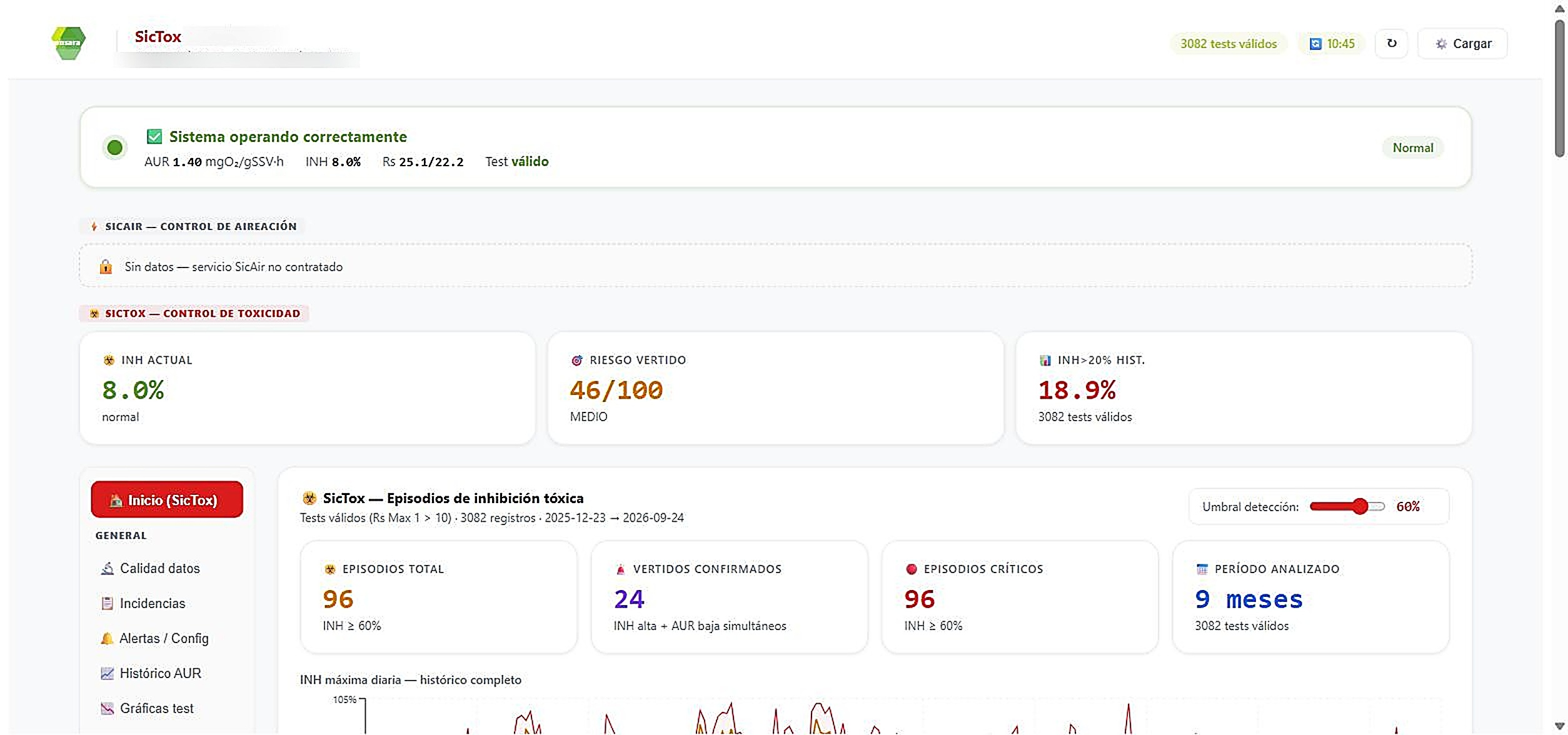
SICTOX panel — toxicity control, episodes and discharge risk (summary view)
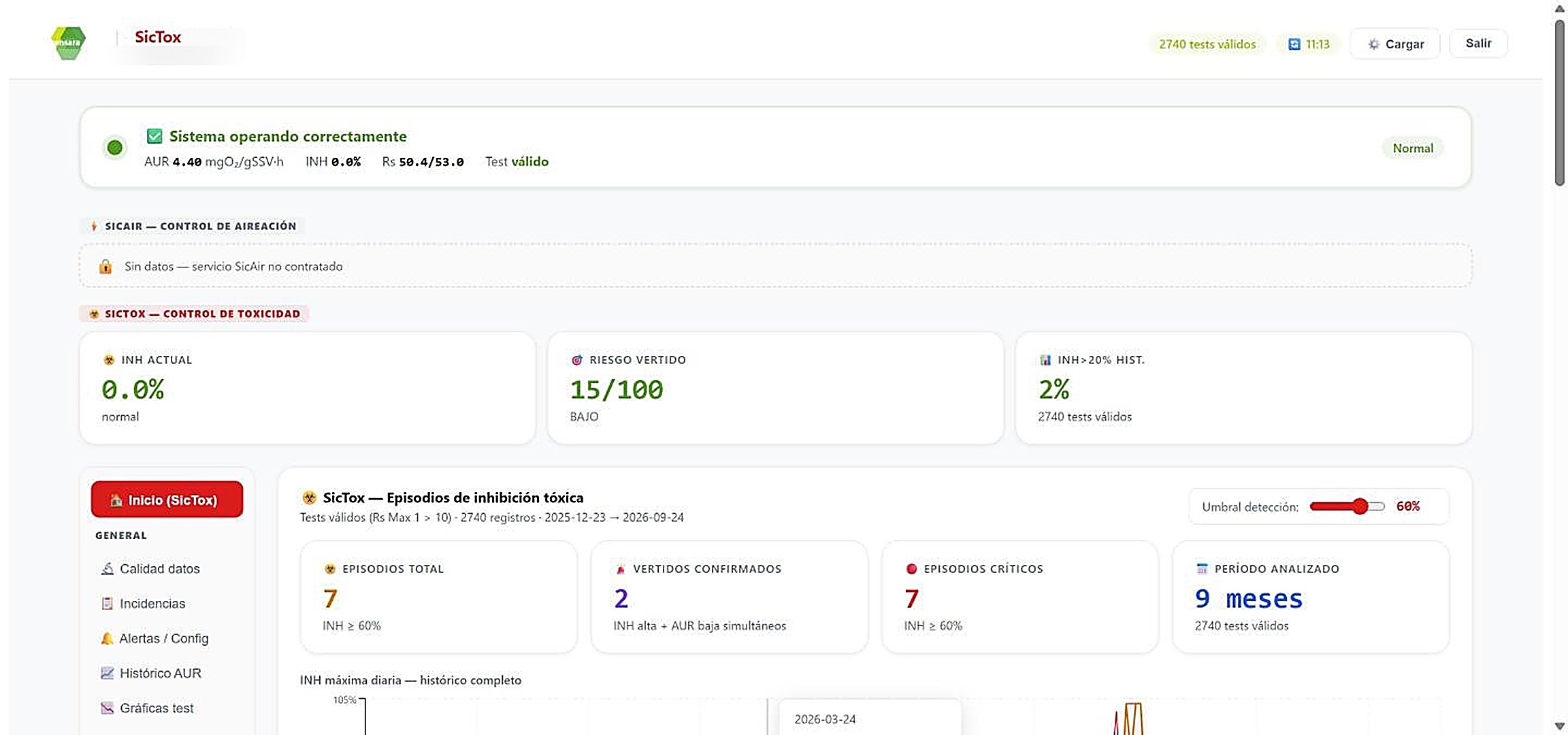
SICTOX panel — second installation
Use cases
Three real situations where SICAIR and SICTOX are already operating (plant names withheld under contractual confidentiality):
Waste management plant — SBR aeration
Analysis of hundreds of aeration cycles revealed a recurring pattern of over-aeration and cycles that failed to reach the endogenous phase. SICAIR quantified the hours and avoidable energy cost involved, and now generates a monthly executive report tracking the trend. With this data, the plant has moved from running 1 aeration cycle to 2 cycles per day, improving process performance. The next step is to use SICAIR to automate each cycle’s duration in real time, instead of setting it manually.
Municipal WWTP — continuous aeration control
SN8 + SICAIR monitor the biological reactor around the clock, predicting short-term oxygen demand and adjusting the blower setpoint accordingly, instead of operating on fixed timers.
Municipal WWTP — toxicity monitoring
Two installations use SICTOX independently to monitor upstream industrial discharges. The system has identified biological inhibition episodes hours ahead of conventional control methods, allowing action before the effluent is affected.
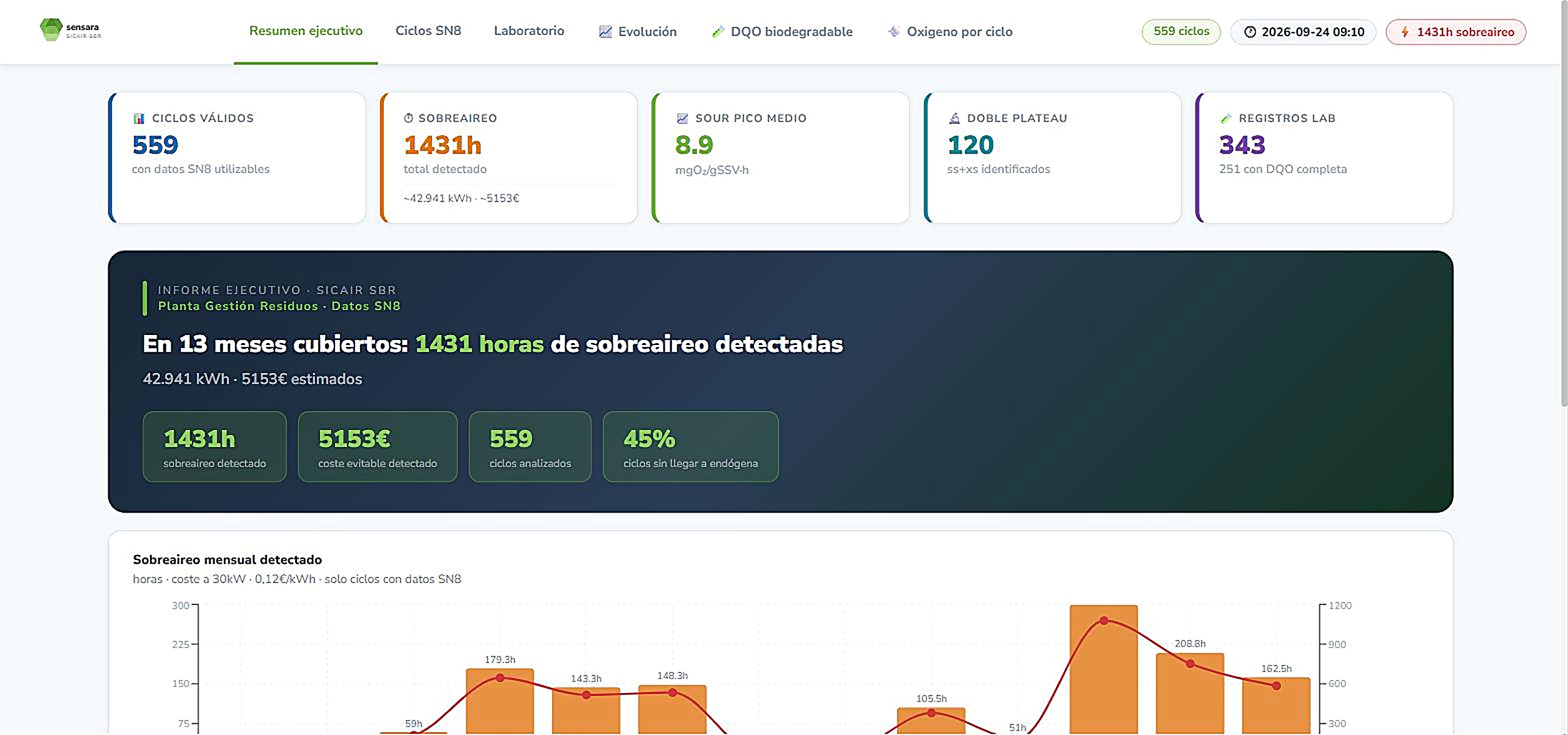
SICAIR SBR executive report — over-aeration detected and avoidable cost
Why a proprietary approach instead of a generic AI model
“Off-the-shelf” machine learning models fail in WWTPs because each plant’s behavior depends on its specific load, biomass and configuration. SENSARA’s approach is based on real respirometric data from each installation — not simulations — and the models are reviewed and updated as plant conditions change, rather than being delivered as a closed black box.
How it works
- The SN8 unit continuously measures respirometric parameters (O2, temperature, pH, Redox) in the biological reactor
- Data is sent to the SENSARA platform (SN8 online 24/7, multi-reactor)
- The SICAIR and SICTOX models process the signal and generate predictions, setpoints and alerts
- The plant operator receives the information on the dashboard and/or integrates it directly into their SCADA
Frequently asked questions
Do I need SICAIR to use SICTOX, or vice versa?
No. They are independent services. A plant can subscribe to only toxicity monitoring (SICTOX) or only aeration optimization (SICAIR), depending on its needs.
Does this replace my SCADA or my current instrumentation?
No. SICAIR and SICTOX integrate with the instrumentation and control system the plant already has; they do not require replacing existing equipment.
How long does it take to deliver reliable results?
The system starts generating predictions from the very first cycle, but accuracy improves with the plant’s historical data; we recommend several weeks of operation for a consolidated assessment.
What do I need to get started?
An SN8 unit installed in the biological reactor. From there, SICAIR and SICTOX are activated as a service on top of that data.